


The WebMCP WordPress Plugin: What It Does, How It Works, and Whether You Need It

Bugs Monkey
Apr 2, 2026
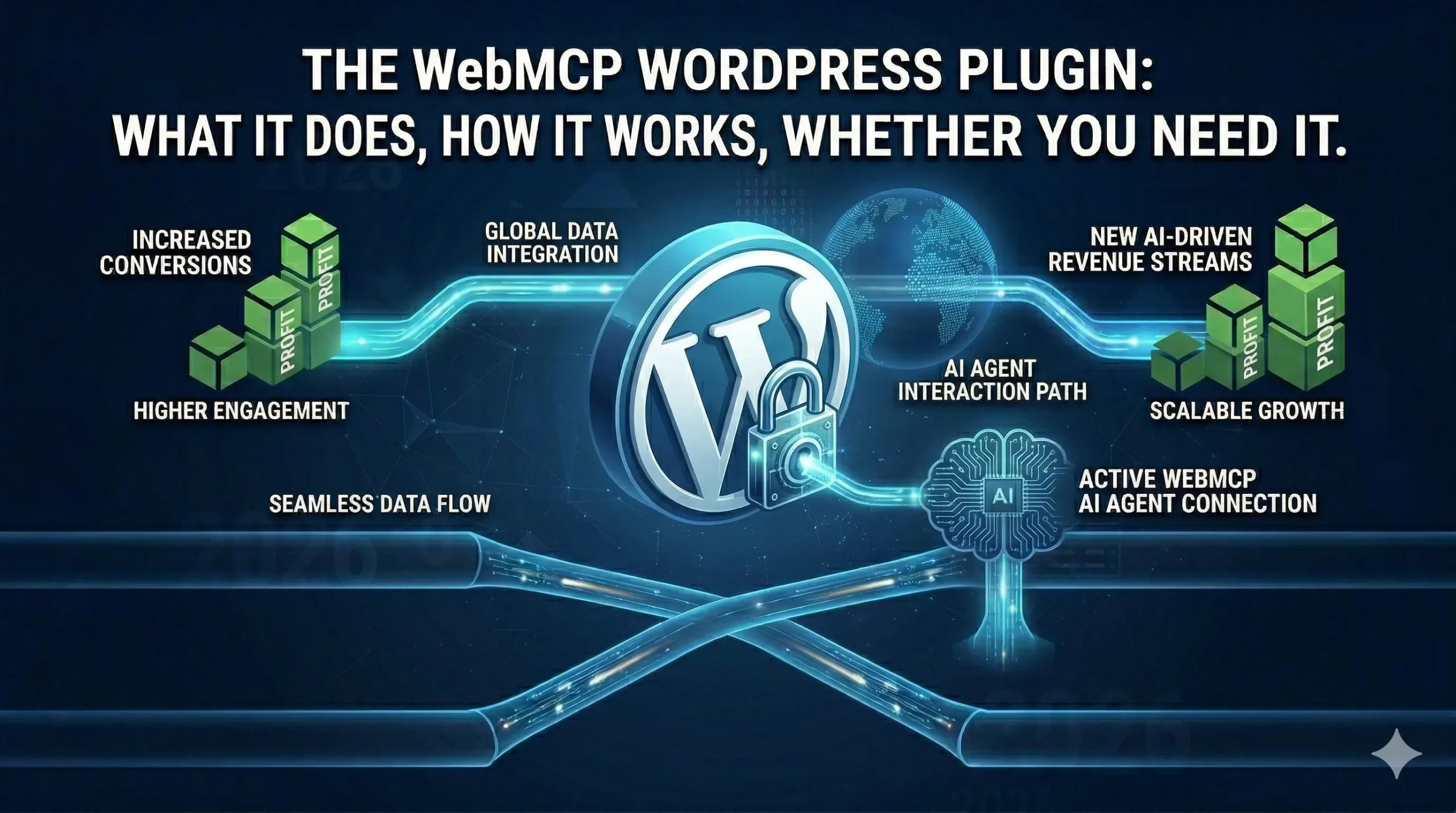
The WebMCP WordPress plugin is a server-side WordPress plugin that exposes your site’s content, structure, and data as a standardized, machine-readable interface for AI agents. In plain terms: it gives AI tools a direct, structured way to read and interact with your WordPress site, without scraping HTML or relying on fragile API workarounds. If you have been hearing about WebMCP and wondering what it actually means for your specific website, this post breaks it down from the ground up.
No jargon fog. Just what the plugin does, why it exists, and whether you should care right now.
A Quick Recap: The Problem WebMCP Was Built to Solve
AI assistants like ChatGPT, Claude, and Gemini are being wired into business workflows at a pace that would have seemed unrealistic two years ago. Scheduling, customer support, content generation, data retrieval, all of it is being handed off to AI agents. But here is the problem most people do not talk about: AI agents are notoriously bad at reading websites.
They either scrape HTML (which is messy and unreliable), call a REST API that your site may not expose cleanly, or simply fail to get the data they need. WebMCP, the open standard backed by Google and Microsoft, was designed to fix this. It gives websites a universal way to describe their content and capabilities to any AI agent that speaks the protocol. Think of it as a handshake between your website and the AI layer that is rapidly being built on top of the internet.
The full story of what WebMCP is and where it came from is worth reading if you are starting from scratch. Come back here once you have the context.
So What Does the WebMCP WordPress Plugin Actually Do?
The plugin is the implementation layer. WebMCP defines the standard; the plugin makes that standard work inside your WordPress installation specifically. Installing it does a few concrete things.
It Creates a Structured Data Endpoint for Your Site
Out of the box, a WordPress site has a REST API, but it is generic and not built with AI agent consumption in mind. The WebMCP WordPress plugin creates an additional endpoint that follows the MCP specification exactly. That means an AI agent connecting to your site gets content in a format it was designed to process, not a pile of JSON it has to interpret and guess at.
Your posts, pages, custom post types, taxonomies, and site metadata all become queryable through a standardized interface. An AI agent can ask “give me the three most recent posts tagged with pricing” and get a clean, reliable answer. That sounds simple. The reliability of it is what is actually new.
It Handles Authentication and Permissions Natively
One of the more overlooked features is that the plugin respects your existing WordPress user roles and permissions. A logged-in user’s AI assistant gets access to the same content that user has access to. Nothing more. If a piece of content is behind a paywall, restricted to editors, or marked private, the MCP endpoint treats it accordingly. You are not opening a backdoor; you are giving a new door that follows the same rules.
It Works With Your Existing Plugins and Post Types
This is where it gets genuinely useful for non-vanilla WordPress setups. The WebMCP WordPress plugin is designed to work with WooCommerce products, Advanced Custom Fields, custom post types registered by your theme or other plugins, and content from page builders like Elementor, as long as that content is stored in the WordPress database in a reasonably standard way.
If your site has a custom schema, the plugin gives developers hooks to expose that data in MCP-compliant format too. That part requires actual development work, but the foundation is there.
What AI Agents Can Do With Your Site Once the Plugin Is Active
This is the part that tends to get people interested quickly, because it moves from theory to real business use cases.
Consider a customer support AI agent embedded in your site. Without WebMCP, it either reads your static FAQ page or has to be manually fed content through a knowledge base upload. With the WebMCP WordPress plugin active, it can query your site’s content directly. When a product page gets updated, the agent reads the updated version. When you publish a new policy post, it is immediately available to the agent. No sync, no re-upload, no lag.
Or think about an AI-powered internal tool your team uses. A sales rep asking “what case studies do we have for SaaS clients in the enterprise tier” gets an accurate answer pulled from your WordPress content library in real time, not from a document someone exported six months ago and forgot to update.
The MCP adapter architecture explains in more depth how this connection actually happens at the protocol level, if you want to go further down that path.
How Hard Is It to Set Up?
For a standard WordPress site with a well-structured theme and no unusual database customizations, installation is straightforward. Plugin installed, activated, basic configuration through the settings panel, and the MCP endpoint is live. A developer can verify it is returning correct data in under an hour.
The more complex picture is when your site has a lot of custom data. Custom post types with nested ACF fields, WooCommerce with custom product attributes, or multisite installations all require additional configuration to expose that data correctly through the MCP interface. This is not a reason to avoid it; it is just an accurate picture of the effort involved.
If your site was built with performance and structure in mind from the start, the work is minimal. If it was stitched together over several years with a rotating cast of developers, there is cleanup involved before WebMCP can surface your content cleanly.
Proper WordPress architecture makes this kind of integration significantly easier. That is worth keeping in mind if you are planning a rebuild anyway.
Headless WordPress and WebMCP: A Natural Fit
If your WordPress site runs on a headless architecture, the WebMCP plugin fits into the picture more naturally than you might expect.
In a headless setup, WordPress already functions as a pure content backend. The front end is decoupled. That means the MCP endpoint can run cleanly on the WordPress layer without any tension with the front-end rendering. AI agents talk to WordPress directly, and your React or Next.js front end stays untouched.
For teams already running headless WordPress, adding WebMCP support is less of a lift than for traditional coupled setups. The content API mindset is already baked in.
If you are curious about how headless architecture changes the performance equation too, the comparison between traditional and headless WordPress covers that in detail.
Who Should Install This Right Now?
Honest answer: not everyone needs to move immediately. But there are specific situations where getting this set up sooner makes clear sense.
If your business is actively building or evaluating AI-powered workflows, installing the plugin now means you are not scrambling to retrofit it later. If you run a content-heavy site where freshness matters (news, product catalogs, documentation), the real-time content access model WebMCP enables is worth the setup time. If you are building customer-facing AI tools, FAQ bots, product recommendation engines, or AI search, connecting them to a live MCP-compliant WordPress back end is a fundamentally more reliable architecture than what most teams are currently using.
The businesses that are moving on this now are not doing it because they fully understand every implication. They are doing it because they understand that AI agents are becoming a real distribution channel, and they want their content ready when that channel opens up fully.
For a broader view of how the open standard behind all of this evolved, the official Model Context Protocol documentation is the most authoritative reference available right now.
Common Misconceptions Worth Clearing Up
A few things get repeated about the WebMCP WordPress plugin that are either wrong or misleading.
First, it is not a chatbot plugin. Installing it does not add any AI features to your site’s front end. It is strictly a server-side interface layer. The AI experience has to be built separately, either through a connected AI tool or through custom development.
Second, it does not expose your entire WordPress database to the internet. The endpoint respects your permission model. It does not create new public access; it creates a structured interface to access what was already accessible, in a more machine-readable way.
Third, it is not a replacement for your REST API. Both can coexist. MCP and REST serve different consumers. Your front end still talks to REST. AI agents talk to the MCP endpoint.
How Bugs Monkey Approaches WebMCP Implementation
At Bugs Monkey, the approach to WebMCP implementation starts with the site’s current architecture. A plugin installation without understanding how your content is structured is a shortcut to an MCP endpoint that returns incomplete or misleading data to AI agents. That is worse than not having it at all.
The process starts with a content architecture audit: what post types exist, how custom fields are structured, what the permission model looks like, whether the site is on traditional or headless WordPress. From there, the plugin gets configured to surface the right content through the MCP interface. For sites with heavily custom schemas, the team writes the additional hooks needed to expose that data correctly.
The goal is not just an active endpoint. It is an endpoint that returns accurate, well-structured, permission-respecting data that an AI agent can actually use. That distinction matters more than the installation step.
The Longer View on This
WebMCP is early. The plugin is actively being developed, the specification is still evolving, and the AI agent landscape it is designed for is changing fast. That is a fair reason to watch rather than act for some businesses.
But the direction is clear. AI agents are becoming search engines, storefronts, support desks, and research tools. The websites that are structured to talk to those agents will surface in places that websites built purely for human browsers will not. WebMCP is one of the foundational pieces of that infrastructure.
Getting the plugin set up correctly now, even if no AI agent connects to it tomorrow, means the infrastructure is ready when the use case becomes unavoidable.
Ready to Get Your WordPress Site WebMCP-Ready?
If your site runs on WordPress and AI integration is on your roadmap, this is a practical first step worth taking properly. A misconfigured MCP endpoint is not neutral; it creates bad data that AI agents will trust and repeat. Getting it right from the start matters.
Start a conversation about WebMCP implementation and get a clear picture of what the setup process looks like for your specific site.