Right now, when an AI agent tries to “book a flight” or “add a product to cart” on your website, it does something embarrassingly primitive. It takes a screenshot. Then it squints at the pixels, tries to figure out where the buttons are, and makes its best guess. If you moved a button 10 pixels to the right last Tuesday, the whole thing breaks.
That is the current state of AI agents on the web. And it’s exactly the problem WebMCP is designed to fix.
Google Chrome shipped an early preview of the Web Model Context Protocol (WebMCP) in February 2026, jointly developed with Microsoft through the W3C. Dan Petrovic called it the biggest shift in technical SEO since structured data. That is not an overstatement. For every business with a website, this is worth understanding now, before it becomes the new standard everyone scrambles to catch up with.
What Is WebMCP, Really?
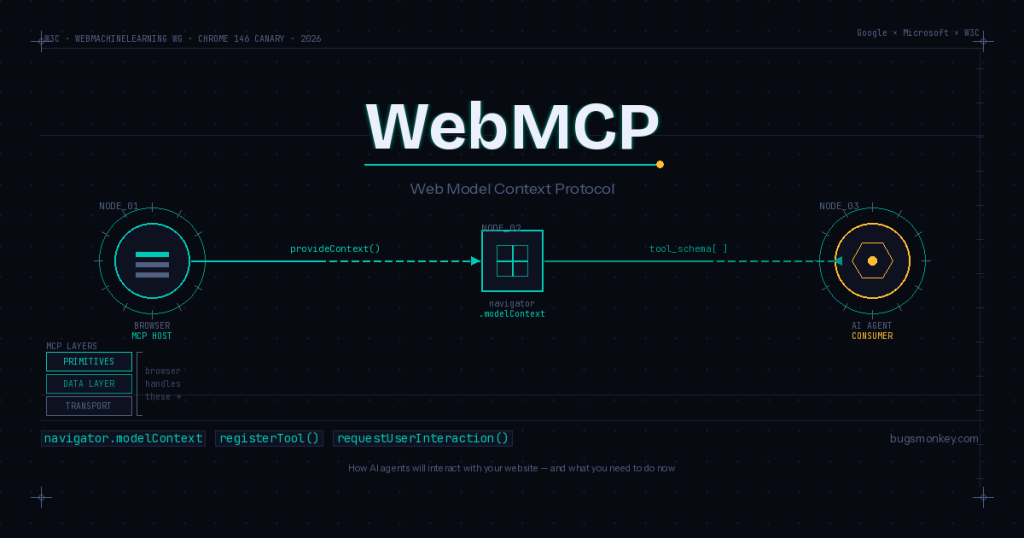
WebMCP stands for Web Model Context Protocol. The short version: it lets your website tell AI agents exactly what it can do, in language the agent can read directly, without guessing, scraping, or screenshot analysis.
WebMCP fixes the existing problem by allowing websites to explicitly publish a “Tool Contract.” Through a new browser API called navigator.modelContext, a site can define clear, callable functions for AI agents to use.
Think of it this way. Right now, your website is a poster on a wall. AI agents stare at it and try to interpret what it means. WebMCP turns your website into an API. The agent no longer stares. It just calls the function.
WebMCP isn’t from a single vendor. It’s Microsoft and Google working closely together through the Web Machine Learning Working Group at W3C, with many people collaborating to shape how AI agents will soon interact with the web.
That’s significant. When two of the largest browser makers co-author a spec under W3C, you’re not looking at an experiment. You’re looking at the future of how the web works.
Why the Old Way Was Already Broken
To understand why WebMCP matters, you have to understand how painful the current approach actually is.
Screenshot-based agents pass images to models like Claude and Gemini. Each screenshot consumes thousands of tokens with long latency. DOM-based approaches ingest raw HTML and JavaScript, consuming context window space and increasing inference cost. A single product search by AI agents can require dozens of sequential interactions.
Every one of those interactions costs money. Every one of them can fail. And none of them give your business any control over what the agent does or how it represents your site.
Your checkout flow gets misread. Your search filters get skipped. Your inventory logic gets ignored. The agent is essentially a blindfolded visitor trying to navigate your site by feel. And you, as the business owner, have zero say in the process.
WebMCP changes that relationship entirely.
How WebMCP Actually Works
The specification introduces two ways for developers to make a website “agent-ready.”
The Declarative API
This is the easier of the two paths. You can expose a website’s functions by adding new attributes to your standard HTML, using toolname and tooldescription inside your <form> tags. Chrome automatically reads these tags and creates a schema for the AI. If you have a ‘Book Flight’ form, the AI sees it as a structured tool with specific inputs.
For a lot of sites, especially those with well-structured forms already in production, this path requires minimal extra work. Clean HTML gets you most of the way there.
The Imperative API
For more complex workflows, developers can define richer tool schemas through registerTool(), conceptually similar to the tool definitions sent to AI API endpoints, but running entirely client-side in the browser. A website can expose functions like searchProducts(query, filters) or orderPrints(copies, page_size) with full parameter schemas and natural language descriptions.
This is where the real power sits. Single-page applications, dynamic product catalogs, multi-step checkout flows, anything with stateful logic, can now expose exactly the right operations to an agent, in exactly the right format.
The spec also has registerTool() and unregisterTool() methods, which is great for single-page apps where you want to enable or disable specific tools based on what’s happening in your app.
That level of granularity is genuinely useful. You can expose a “search products” tool on the catalog page and swap it out for a “manage subscription” tool on the account page. The agent always sees the right capabilities for the context.
What This Does for Performance and Cost
The numbers here are worth paying attention to.
By using structured JSON schemas instead of vision-based processing, WebMCP leads to a 67% reduction in computational overhead and pushes task accuracy to approximately 98%.
For any business running AI-assisted workflows or thinking about agentic commerce, those figures are material. Lower inference costs. Fewer failed transactions. Faster task completion. A single tool call through WebMCP can replace what might have been dozens of browser-use interactions, where an agent would otherwise click through filter dropdowns, scroll through paginated results, and screenshot each page.
For e-commerce in particular, the implications are direct. If you’re thinking about how AI agents will shop on behalf of users, you want your site structured so agents work through you correctly, not around you clumsily.
The Human-in-the-Loop Design
Here’s one of the more thoughtful parts of the spec. WebMCP is not designed to let AI agents run wild.
The standard is explicitly designed around cooperative, human-in-the-loop workflows, not unsupervised automation. The WebMCP specification identifies three pillars: Context (all the data agents need to understand what the user is doing), Capabilities (actions the agent can take on the user’s behalf), and Coordination (controlling the handoff between user and agent when the agent encounters situations it cannot resolve autonomously).
The spec has agent.requestUserInteraction() to let tools ask the browser to get user confirmation before doing something. This is to keep the human in the loop, and prevent an AI agent from completing a purchase without asking you first.
That’s not a limitation. That’s a trust layer. The agent can handle the research and filtering. The human approves the final action. That’s a workflow that actually makes sense for real business scenarios.
What This Means for SEO and Technical Web Strategy
SEO professionals are already calling this the biggest shift in technical SEO since structured data. Search Engine Roundtable That framing makes sense when you consider the direction AI search is heading.
If AI agents are increasingly making decisions about which products to buy, which services to book, and which forms to fill out, then your site’s ability to communicate clearly with those agents becomes a competitive advantage. Not just a nice-to-have. A direct factor in whether an agent completes a task on your site or moves to a competitor’s.
The parallel to structured data is worth taking seriously. Businesses that adopted schema markup early got outsized visibility in rich results. The same pattern will likely repeat here. Early adoption of WebMCP gives your site a head start in being “agent-readable” before the crowd catches up.
For web performance context, the same underlying principle applies: speed, structure, and clarity signal credibility, both to search engines and now to AI agents. If you’ve been following the conversation around Core Web Vitals and how they affect your search rankings, the connection here is natural. A well-built, well-structured site adapts more easily to standards like WebMCP because the foundation is already clean.
Where Things Stand Right Now
WebMCP is currently available in Chrome 146 Canary behind the “WebMCP for testing” flag at chrome://flags. Other browsers have not yet announced implementation timelines, though Microsoft’s active co-authorship of the specification suggests Edge support is likely.
Industry observers expect formal browser announcements by mid-to-late 2026, with Google Cloud Next and Google I/O as probable venues for broader rollout announcements. The specification is transitioning from community incubation within the W3C to a formal draft, a process that historically takes months but signals serious institutional commitment.
It is early preview stage. That’s exactly the right time to start paying attention. The spec is stable enough to understand and plan around. It’s not so far along that you’ve already missed the window.
Patrick Brosset from the Microsoft Edge team breaks down the full technical picture, including exactly how WebMCP relates to Anthropic’s MCP protocol and why the browser handles the transport layer so you don’t have to.
What Kind of Sites Need to Prepare First
Not every site has the same urgency here. But some categories need to move sooner.
E-commerce stores are at the front of the queue. If AI agents are going to shop on behalf of users, the sites that publish clear searchProducts, addToCart, and checkout tools will get reliable agent-driven traffic. Sites without WebMCP support will get scraped badly, or skipped entirely. For anyone running a high-converting store, this connects directly to the underlying principles of e-commerce development built for long-term performance.
Travel and booking platforms face the same dynamic. Live pricing, seat selection, booking confirmation flows, these are exactly the kinds of multi-step workflows that agents struggle with through DOM scraping and handle perfectly through structured tool calls.
SaaS and web apps built on React or similar frameworks benefit from the imperative API, where tool registration and deregistration can be tied directly to the application’s routing and state. The agent sees the right tools at the right time.
WordPress-powered sites, especially those using headless architectures, have a clear path here too. The API layer that separates your front-end from WordPress’s back-end is exactly the kind of structure WebMCP plugs into naturally. If you’ve been considering headless WordPress for speed and flexibility, the agentic web gives you another concrete reason to take it seriously.
How to Get Ahead of This
The practical steps are not complicated. Most of them are things you should be doing anyway.
Start with your HTML. Clean, well-structured forms with clear labels are 80% of the way to Declarative API compatibility. If your forms are messy, now is the reason to fix them.
Map your site’s core actions. What are the five to ten things a user most commonly comes to your site to do? Those are your future WebMCP tools. Define them clearly now, even if implementation comes later.
For web apps and complex sites, think in terms of a JavaScript tool library. The same functions your front-end team already uses to handle business logic can be wrapped and registered as WebMCP tools with relatively little extra work.
Finally, get comfortable with the spec. The WebMCP proposal on GitHub is readable and well-organized. The Chrome early preview program is the place to test.
Building for the Agentic Web
WebMCP is a good example of something that starts in developer circles and ends up reshaping how every business on the web operates. The businesses that think about this early will have cleaner architectures, faster agent workflows, and more reliable automated transactions when the standard reaches general availability.
Bugs Monkey builds sites and web apps that are structured for performance from the ground up. Whether that’s clean component architecture in React, headless WordPress implementations, or custom API integrations, the same principles that make a site fast and reliable today are the ones that make it agent-ready tomorrow.
If you’re thinking about how your site fits into the agentic web or you want to audit your current structure against where things are heading, start a conversation here. No pressure, just a clear-headed look at what your site needs.
WebMCP is still early. But the direction is clear. The web is getting a new interface layer, one designed for machines as much as humans. The sites that are ready will have a measurable advantage. The ones that scramble to retrofit it later will spend more money and get there slower.
Getting your foundation right now is the smarter move.
Further reading: If you want to understand how site speed and structure already affect your search performance before AI agents enter the picture, this breakdown of WordPress performance and Core Web Vitals is a useful starting point.