You’re getting traffic. Google Analytics shows healthy visitor numbers. But your conversion rate? Abysmal.
Before you blame your copy or redesign your entire site, check your Core Web Vitals. These three metrics don’t just affect where you rank on Google. They directly influence whether visitors stick around long enough to become customers.
Here’s the uncomfortable truth: Google is sending people to your site, but your slow, janky pages are sending them straight to your competitors.
What Are Core Web Vitals and Why Should You Care
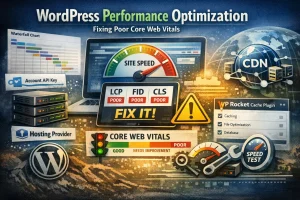
Core Web Vitals are three specific page experience metrics Google uses to measure how real users experience your website:
Largest Contentful Paint (LCP): How fast your main content loads. Good is under 2.5 seconds. Anything over 4 seconds? Your visitors are already gone.
Interaction to Next Paint (INP): How quickly your page responds when someone clicks, taps, or types. Under 200 milliseconds is the target. Laggy buttons kill conversions faster than bad design.
Cumulative Layout Shift (CLS): Whether your page elements jump around while loading. Ever tried to click a button only to have an ad push it down at the last second? That’s CLS, and it’s infuriating.
These aren’t vanity metrics. They’re measurements of user frustration.
The Direct Line Between Core Web Vitals SEO and Rankings
Google confirmed in 2021 that Core Web Vitals are ranking factors. But unlike traditional SEO signals, these metrics measure actual user experience, not just technical optimization.
A site with perfect keyword targeting and solid backlinks can still lose rankings to a faster competitor. Why? Because Google knows that sending users to slow sites creates a poor search experience.
Bugs Monkey has seen this firsthand. Clients with decent content and strong domain authority were stuck on page two. After fixing their Core Web Vitals, they jumped to page one within weeks. Same content. Same backlinks. Better user experience.
The algorithm doesn’t care about your excuses. It cares about bounce rates, dwell time, and whether users come back to the search results frustrated.
When your site loads slowly or responds sluggishly, Google notices. More importantly, your potential customers notice.
The Conversion Killer Nobody Talks About
Rankings matter, but conversions pay the bills.
A one-second delay in page load time reduces conversions by 7%. That’s not a typo. For every second your visitors wait, 7% of them decide to shop elsewhere.
Think about your own behavior. You land on a product page. It takes three seconds to load. The images pop in late. The “Add to Cart” button shifts down just as you’re about to click it. Are you buying from that site? Or are you hitting the back button?
Core Web Vitals directly correlate with these friction points:
Poor LCP means visitors stare at a blank screen or loading spinner. Most people give you three seconds. After that, they’re bouncing.
Bad INP makes your site feel broken. Clicks don’t register immediately. Forms lag. Buttons seem unresponsive. Users assume your site is buggy or their internet is failing. Either way, they leave.
High CLS destroys trust. When elements jump around, visitors question whether your site is professional enough to trust with their credit card information.
An e-commerce client came to us with this exact problem. They had 50,000 monthly visitors but a 0.8% conversion rate. After analyzing their site, the issues were obvious: 4.2-second LCP, 350ms INP, and a CLS score of 0.4. Their mobile experience was even worse.
We migrated them to a headless architecture, optimized their image delivery, and restructured their JavaScript loading. Three months later: LCP under 2 seconds, INP at 150ms, CLS at 0.05.
Their conversion rate? 2.4%. Same traffic volume. Triple the revenue.
Mobile Performance: Where Most Sites Fail
Desktop users are forgiving. Mobile users are ruthless.
Google’s mobile-first indexing means your mobile Core Web Vitals matter more than your desktop scores. Yet most sites optimize for desktop and treat mobile as an afterthought.
Mobile users have less patience, slower connections, and smaller screens where layout shifts are more noticeable. If your mobile LCP is over 3 seconds, you’re losing half your mobile traffic before they see your content.
This matters because mobile drives 60% of search traffic. If your mobile Core Web Vitals are poor, your core web vitals SEO strategy is fundamentally broken.
The traditional WordPress approach struggles here. Heavy themes, bloated plugins, and render-blocking resources create mobile performance nightmares. Your desktop might load fine, but your mobile experience is driving away the majority of your audience.
The Technical Reality of Poor Core Web Vitals
Bad scores don’t appear randomly. They’re symptoms of specific problems:
Slow servers create high LCP. If your Time to First Byte (TTFB) is over 600ms, your server is the bottleneck. Cheap shared hosting might save $10/month, but it’s costing you thousands in lost conversions.
Unoptimized images kill LCP and contribute to CLS. A 3MB hero image might look beautiful, but it takes 8 seconds to load on a 4G connection. Your visitor is gone in three.
Third-party scripts destroy INP. Every analytics tag, chat widget, and social media button adds JavaScript that competes for your user’s browser resources. Most sites load 15-20 third-party scripts. Each one adds latency.
Layout instability comes from images without dimensions, web fonts loading late, or dynamic content injecting after initial render. Each shift chips away at user trust.
An analysis of over 13 million websites found that only 40% pass all three Core Web Vitals thresholds. That means 60% of sites are actively hurting their own performance.
Fixing Core Web Vitals Without Breaking Your Site
Improving scores requires balancing performance with functionality. You can’t just delete everything and call it optimized.
Start with measurement. Google Search Console shows your real-world Core Web Vitals data. Not synthetic lab tests, but actual user experiences. Focus on fixing the URLs with the most traffic first.
For LCP: Upgrade your hosting if TTFB is slow. Compress images and serve them in modern formats like WebP. Implement lazy loading for below-fold content. Use a CDN to serve assets from servers closer to your users.
For INP: Reduce JavaScript execution time. Break up long tasks. Defer non-critical scripts. Remove or replace heavy third-party tools. Every tag manager, heatmap tool, and popup plugin adds overhead.
For CLS: Set explicit width and height attributes on images and videos. Preload web fonts. Reserve space for dynamic content and ads. Test on actual mobile devices, not just Chrome DevTools.
A custom development approach often outperforms template-based solutions because you control every byte sent to the browser. Off-the-shelf themes bundle features you don’t need, creating bloat that tanks your scores.
The Business Case for Better Performance
Fixing Core Web Vitals isn’t a technical project. It’s a revenue project.
Calculate your current conversion rate and average order value. Then multiply by 7% for every second you reduce load time. That’s your potential revenue increase.
For a site doing $500,000 in annual revenue with a 3-second load time, reducing it to 2 seconds could add $35,000. Reduce it to 1.5 seconds? Another $17,500.
These aren’t theoretical numbers. They’re conservative estimates based on documented conversion rate improvements.
The SEO benefits compound this. Better rankings mean more traffic. Better user experience means higher conversion rates. You’re not just getting more visitors. You’re converting them at higher rates.
Your Next Step
Check your Core Web Vitals in Google Search Console right now. If you’re seeing red or orange warnings, you have work to do.
The question isn’t whether poor Core Web Vitals are costing you money. They are. The question is how much longer you’re willing to let that continue.
Performance optimization isn’t a one-time fix. It’s an ongoing process of monitoring, testing, and refining. But the sites that treat it as a priority consistently outrank and outperform competitors who don’t.
Getting traffic but no conversions? Your Core Web Vitals are probably the reason. Fix them, and watch what happens to your bottom line.